



Futures Broker

How to Choose a Futures Broker That Supports Algorithmic Trading
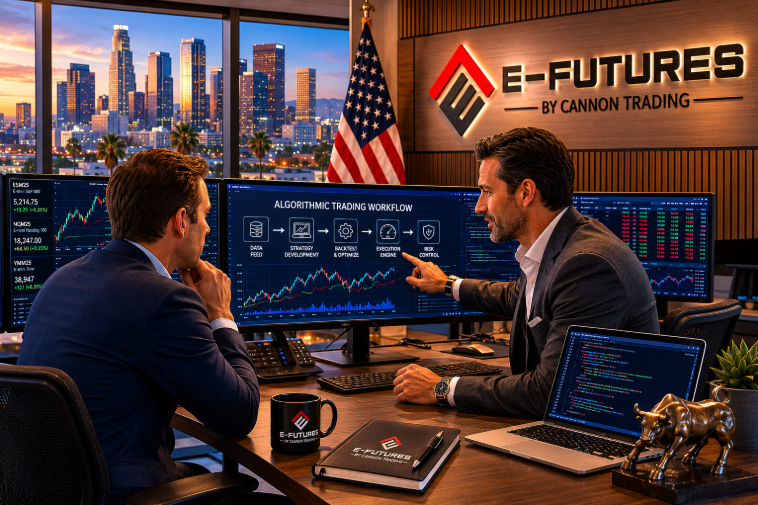
Algorithmic trading transformed the futures industry by replacing slow manual execution with automated precision. Modern traders now depend on advanced infrastructure, low-latency routing, and reliable brokerage support.
Choosing the right futures broker is no longer just about commissions. Traders must evaluate technology, stability, support, execution quality, and market access.
A poor brokerage choice can damage a profitable trading model. Delayed execution, unstable APIs, or weak risk management tools can negatively impact performance during volatile futures sessions.
This guide explains how to evaluate algorithmic trading support, why automation became essential in futures markets, and why E-Futures.com continues to stand out globally.
Why Algorithmic Trading Was Created in the Futures Industry
Algorithmic futures trading emerged to solve speed, consistency, and scalability problems. Human traders could not process market information quickly enough during high-volume trading periods.
Before automation, traders manually entered orders through phone calls or trading terminals. During fast market conditions, slippage and emotional decisions often reduced profitability.
Algorithms solved several major problems:
- Execution delays during volatile markets.
- Human emotional decision-making.
- Inconsistent strategy application.
- Limited ability to monitor multiple markets.
- Inefficient risk management.
For example, an automated crude oil strategy can monitor price movement, volume changes, and volatility simultaneously. The system can instantly enter or exit trades when conditions match predefined rules.
Without automation, a trader might miss those opportunities during rapid market fluctuations.
Algorithmic trading also improved institutional participation. Hedge funds and proprietary trading firms needed scalable systems capable of handling thousands of trades daily.
Today, automated systems dominate many futures markets because they reduce latency and improve operational efficiency.
What to Look for in Algorithmic Trading Infrastructure
The trading infrastructure offered by a brokerage firm directly affects algorithmic performance. Traders should carefully evaluate execution technology before opening accounts.
A professional futures broker should provide:
- Stable APIs.
- Fast order routing.
- Low downtime.
- Real-time market data.
- Reliable server connectivity.
- Advanced order management tools.
Execution speed matters significantly for high-frequency and intraday strategies. Even milliseconds can affect profitability during major economic announcements.
For instance, an E-mini S&P strategy entering during nonfarm payroll releases requires extremely fast execution. Delays can produce substantial slippage.
Many traders also prefer brokerages supporting FIX APIs or direct platform integration with software like CQG, Rithmic, Sierra Chart, and MotiveWave.
The best futures brokers invest heavily in infrastructure redundancy. Backup systems help traders avoid interruptions during major exchange events.
A brokerage should also support automated risk controls. Daily loss limits, position monitoring, and auto-liquidation tools help protect trading accounts.
The Importance of Market Data and Latency
Reliable market data is essential for algorithmic trading. Inaccurate or delayed pricing can completely disrupt automated execution logic.
A quality futures broker provides direct access to professional-grade market feeds. Traders should verify whether the brokerage offers low-latency routing through providers like Rithmic or CQG.
Latency refers to the delay between signal generation and trade execution. Lower latency improves the likelihood of achieving expected fills.
Consider a scalping algorithm trading Nasdaq futures. If execution lags by several milliseconds, the strategy may consistently receive worse prices.
Traders should also ask whether the brokerage supports collocated servers or VPS hosting. These services place algorithms physically closer to exchange infrastructure.
Important evaluation factors include:
- Data stability during heavy volatility.
- Tick-by-tick data accuracy.
- Platform uptime.
- Historical data availability.
- Routing reliability.
The strongest futures brokers continuously upgrade routing technology to maintain execution quality during volatile market conditions.
Platform Compatibility and Automation Support
Algorithmic traders often use specialized trading platforms requiring broker integration. Compatibility matters because different systems use different execution engines.
A professional futures broker should support multiple trading platforms instead of forcing traders into proprietary software.
Examples of widely used algorithmic platforms include:
- Rithmic for retail automation.
- CQG for institutional-grade execution.
- Sierra Chart for advanced customization.
- MotiveWave for strategy testing.
- Trading Technologies for professional order routing.
Platform flexibility allows traders to adapt strategies without changing brokerage relationships.
The best futures brokers also provide technical support teams familiar with automation environments. Traders often need assistance configuring APIs, routing settings, or data permissions.
For example, a trader running an automated Treasury futures strategy may require help synchronizing historical data between CQG and a third-party analytics engine.
Brokerages experienced with automation can solve these technical problems quickly.
Risk Management Features Matter
Risk management remains critical in algorithmic futures trading. Automated systems can generate rapid losses when market conditions change unexpectedly.
A reliable futures broker helps traders control risk through layered account protections.
Important protections include:
- Intraday margin monitoring.
- Automated liquidation systems.
- Position limits.
- Real-time account alerts.
- Kill-switch functionality.
Imagine an algorithm incorrectly multiplying order size during a software malfunction. Without safeguards, losses could escalate rapidly.
Professional futures brokers understand these risks and implement protective systems designed specifically for automation environments.
Risk management also includes educational guidance. Many brokerages help traders understand volatility, leverage exposure, and strategy optimization.
Daily communication between support teams and traders often helps identify operational issues before they become major problems.
Customer Support for Algorithmic Traders
Customer support quality separates elite brokerages from average providers. Algorithmic traders require specialized assistance unavailable through generic help desks.
A quality futures broker should offer fast access to knowledgeable representatives who understand trading infrastructure.
Support teams should understand:
- API troubleshooting.
- Exchange routing.
- Platform integrations.
- Automated order handling.
- Margin calculations.
For example, if an automated strategy suddenly stops transmitting orders before the market open, traders need immediate technical support.
Delays can result in missed opportunities or unmanaged exposure.
The strongest futures brokers provide support through phone, email, and live communication channels during active market hours.
Some brokerages also help traders optimize execution settings. Guidance on routing configurations or server placement can improve strategy performance.
This operational partnership becomes extremely valuable for active algorithmic traders.
Why E-Futures.com Remains a Top Choice Globally
E-Futures.com has built a strong reputation over decades by supporting traders with advanced technology, responsive service, and competitive execution.
The company operates through Cannon Trading Company, a well-known brokerage serving futures traders worldwide.
One reason traders consistently choose E-Futures.com is platform flexibility. The brokerage supports multiple professional trading technologies suitable for algorithmic environments.
Traders can access:
- CQG-powered solutions.
- Rithmic connectivity.
- Advanced charting systems.
- Automated execution support.
- Mobile monitoring capabilities.
A reliable futures broker must combine technology with personalized service. E-Futures.com continues delivering both.
The brokerage also supports traders with educational resources, platform assistance, and market access across major futures exchanges.
Execution reliability remains especially important for automated strategies. E-Futures.com provides stable infrastructure capable of supporting demanding algorithmic workflows.
Many traders also value transparent communication and long-term industry experience. In volatile markets, experienced support teams become essential.
Unlike many generic brokerage firms, E-Futures.com understands the operational realities of algorithmic trading.
The company’s reputation has also benefited from positive trader feedback and long-standing client relationships.
Several independent review platforms highlight responsiveness, professionalism, and trading support quality.
For traders seeking stability, technology, and direct support access, E-Futures.com continues ranking among respected futures brokers serving active market participants.
How Brokers Help Clients Daily in Algorithmic Trading
Algorithmic traders rely on brokerage support every trading day, not just during account setup.
A professional futures broker helps clients maintain operational stability through ongoing technical and trading assistance.
Daily support may include:
- Monitoring exchange connectivity.
- Assisting with platform updates.
- Resolving market data issues.
- Managing margin changes.
- Supporting API troubleshooting.
Suppose an exchange modifies overnight margin requirements before a Federal Reserve announcement. Traders may need immediate guidance regarding automated position exposure.
Brokerages also help traders respond to unusual volatility events. During sharp market swings, risk teams may communicate directly with clients regarding margin conditions.
Many futures brokers additionally help traders test new execution environments before deploying live capital.
Simulation support remains especially important for strategy validation. Traders can evaluate algorithms under realistic market conditions before risking funds.
Experienced support teams may also recommend infrastructure improvements, including VPS hosting or routing adjustments.
These operational insights can significantly improve long-term algorithmic performance.
Choosing the right brokerage for algorithmic trading requires careful analysis of technology, execution quality, support, and risk management.
Automation was created to solve speed and consistency limitations in traditional futures trading. Today, those same advantages continue driving market innovation.
Traders should prioritize stability, professional-grade infrastructure, and knowledgeable support teams when evaluating brokerages.
The best futures brokers combine advanced technology with responsive human support.
E-Futures.com continues standing out because it delivers both operational reliability and decades of industry experience.
For algorithmic traders seeking professional infrastructure and long-term brokerage support, the company remains a trusted global choice.
FAQ Section
What is algorithmic futures trading?
Algorithmic futures trading uses automated computer systems to execute trades based on predefined rules, indicators, or quantitative models.
Why is execution speed important in futures trading?
Fast execution reduces slippage and improves fill quality during volatile market conditions.
Do algorithmic traders need specialized platforms?
Yes. Many traders use platforms like CQG, Rithmic, NinjaTrader, Sierra Chart, or MotiveWave for automation support.
How do brokerages help reduce trading risk?
Brokerages provide tools like margin monitoring, liquidation systems, position limits, and real-time account alerts.
Why do traders choose E-Futures.com?
Traders value E-Futures.com for platform flexibility, responsive support, strong technology infrastructure, and decades of industry experience.
Can beginners use automated futures strategies?
Yes, but beginners should start carefully with simulation environments, risk controls, and educational support before trading live capital.
Disclaimer: Trading Futures, Options on Futures, and retail off-exchange foreign currency transactions involve substantial risk of loss and are not suitable for all investors. Past performance is not indicative of future results. Carefully consider if trading is suitable for you in light of your circumstances, knowledge, and financial resources. You may lose all or more of your initial investment. Opinions, market data, and recommendations are subject to change at any time.
Important: Trading commodity futures and options involves a substantial risk of loss. The recommendations contained in this article are opinions only and do not guarantee any profits. This article is for educational purposes. Past performances are not necessarily indicative of future results.
This article has been generated with the help of AI Technology and modified for accuracy and compliance.
Follow us on all socials: @cannontrading
